agentOS Block Manager
BlogContactFAQFeaturesHow it worksIntegrationsSecurityUse cases
Get started
agentOS Block ManagerGet started
agentOS Block Manager
HomeBlogContactFAQFeaturesHow it worksIntegrationsSecurityUse cases
Get started
agentOS Block Manager
BlogContactFAQFeaturesHow it worksIntegrationsSecurityUse cases
TermsPrivacyData Processing

© 2026 agentOS Block Manager

FAQ

Questions agents ask before they commit

We've answered the sharpest objections honestly — compliance scope, data security, banking, migration, and what the platform actually does versus what it can't do yet. If something isn't covered, email us at sf-core-org-support-agentos-block-manager@saas-factory.ai

REAL PRODUCT — REAL SCREENS

Built for the realities of block management — not a generic property tool dressed up

agentOS Block Manager ships 105 features specific to residential block and leasehold management — from Section 20 consultation tracking to RICS-compliant two-account structures, AGM management, reserve fund gap analysis, and Calmony client money banking. It is not a horizontal property platform with block management bolted on.

  • RICS-compliant two-account structure enforced by default

  • FCA-aligned client money ring-fencing per block

  • Section 20 statutory consultation workflow built in

  • Reserve fund gap analysis with year-by-year projection

  • Five role levels — from Principal down to Leaseholder portal
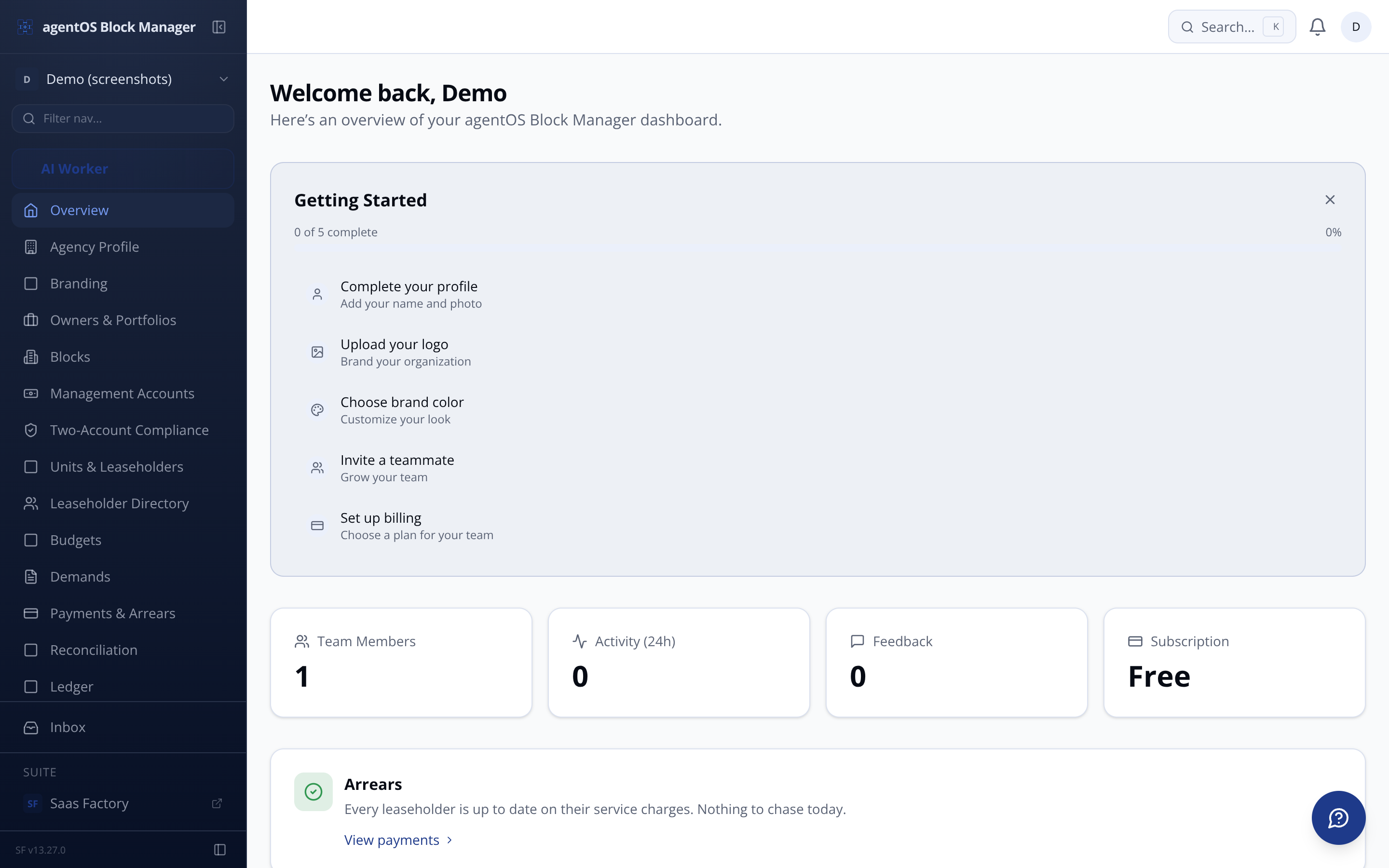
agentOS Block Manager dashboard showing portfolio overview

UK GDPR & data residency

All personal data is stored in UK-based data centres. Subject access requests, right to erasure, and a data processing agreement are supported. Compliance audit trail is immutable and cannot be deleted.

AES-256 encryption throughout

Financial data is encrypted at rest using AES-256 and in transit using TLS 1.2 or higher. Each managing agent's data is strictly isolated — no cross-tenant data access at any layer.

Client money never commingles

Management fee income is always tracked as a separate category and never mixed with block-level client funds. FCA-aligned ring-fencing is enforced per block for all Calmony accounts.

[ COMPLIANCE / CERTIFICATES ]

No certificate slips through because no one remembered to check

The Certificate Register holds fire risk assessments, EWS1, asbestos surveys, EICR, lift inspections, gas safety, legionella, and PAT testing for every block. Automated reminders fire at 90, 30, and 7 days before expiry. The portfolio compliance view shows a RAG grid across every block and certificate type at once.

Compliance Works assets in the Asset Register link directly to certificate records — so regulatory deadlines are always reflected in your reserve fund capex forecast, not buried in a separate system.
Activity and compliance audit trail dashboard

Still have a question we haven't answered?

We'd rather you ask than assume. Reach the team directly at sf-core-org-support-agentos-block-manager@saas-factory.ai — or join the waitlist and we'll follow up as part of your onboarding conversation.

Join the waitlist
agentOS Block Manager

The operating system for residential block management

105 features shipping today. Enterprise-grade compliance, banking, and financial planning — accessible to a one-person operation and a growing portfolio firm alike.
Your questions, answered without spin

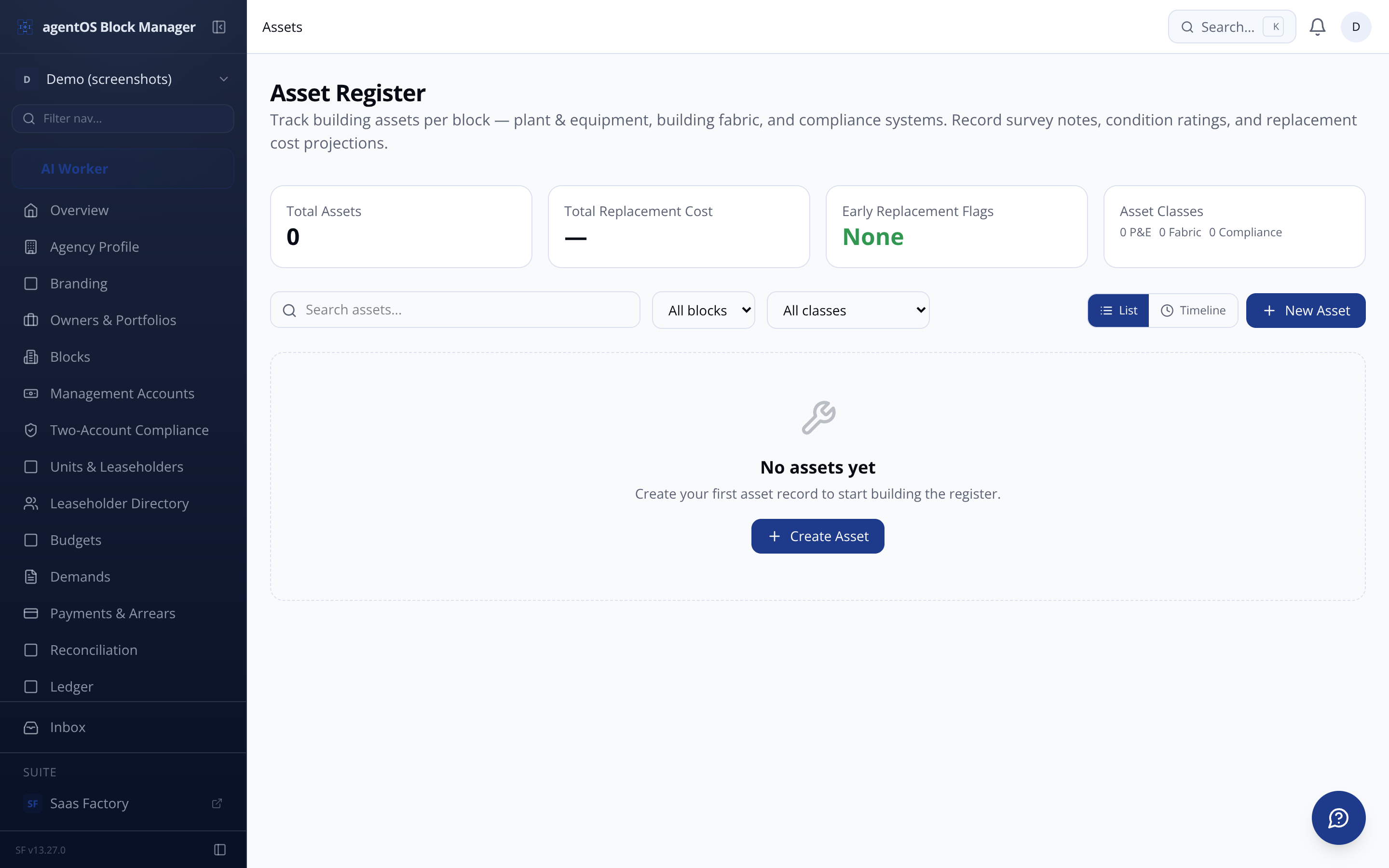
Asset register showing capital expenditure planning and reserve fund projection
[ RESERVE FUND / ASSET LIFECYCLE ]

The reserve fund model that actually tells you where the gap is

Year-by-year projections run across a 20-year horizon. The Asset Register feeds directly into the reserve fund gap analysis in real time — when an asset condition drops to 1 or 2, or a Compliance Works deadline shifts, the forecast updates immediately and alerts surface on the block dashboard.

  • Inflation uplift configurable per block — not a fixed platform default

It does more than show a balance. The engine runs a year-by-year projection across up to 20 years, starting from your live reserve fund balance, adding monthly contributions with an inflation uplift you set per block, and deducting each forecast replacement event in the year it falls due. When any future year shows a shortfall, an alert fires automatically on the block dashboard and your agent-level dashboard, naming the specific assets driving the gap and the exact shortfall amount. You can then run scenario models — adjusting contributions, replacement dates, or inflation assumptions — without clearing the alert until the gap is genuinely resolved. It is connected in real time to the asset register, so any condition rating change or cost update on an asset immediately ripples through the projection.
The platform connects to Xero (UK edition), QuickBooks Online (UK edition), and Sage Online, all via OAuth 2.0 authentication. These connectors pull the P&L report directly from your existing accounting system and display it inside Block Manager — they are not ledger sources and they do not replace your accountant's workflow. For blocks where you are not using an external accounting package, the platform builds the P&L from its own unified ledger, which consolidates transactions from TrueLayer open banking, Calmony, and manual CSV imports into a single view. The agent-facing P&L interface looks the same regardless of source. Sage requires an additional nominal code mapping step to align its chart of accounts to Block Manager's reporting categories.
Each block's funds are ring-fenced at the account level. Calmony accounts opened through the platform are individually ring-fenced as client money, kept entirely separate from other blocks' funds and from the agent's own money, in compliance with RICS client money protection requirements and FCA client money rules where applicable. Management fee income is tracked as a distinct transaction type and nominal code category and is never reported alongside block client funds in any ledger or P&L output. The platform enforces this separation as a hard rule — no cross-block fund transfers are permitted except through a formal payment request workflow, and portfolio reporting is always scoped to a single owner's blocks, because different owners' funds are legally distinct client money.
Every leaseholder has an individual ledger recording every demand raised and every payment received, producing a live running balance at all times. Arrears are recalculated continuously as payments arrive, including partial payments and payment plan instalments. The arrears dashboard gives each unit a RAG status with days overdue and total outstanding, and the portfolio view surfaces your top blocks by arrears so nothing slips unnoticed. Payments imported via TrueLayer or Calmony are auto-matched to open demands by reference and amount, reducing manual reconciliation work. Unmatched payments go to a suspense queue flagged for your review rather than being silently ignored. Service charge demands are dispatched as branded PDF letters with a QR code payment reference, and the communications centre lets you target bulk messages specifically at leaseholders in arrears.
Yes. The Section 20 tracker manages the full three-stage statutory process under the Landlord and Tenant Act 1985 for contracts exceeding £250 per unit: Notice of Intention, Notice of Proposal with contractor nominations and estimates, and Award Notice. Each stage records dispatch dates, observation period deadlines, and leaseholder responses. The platform generates compliant notice documents as PDFs and sends an automated reminder five days before each observation period closes so a missed deadline is not a realistic risk. A status timeline shows the current stage, days elapsed, and next deadline at a glance. All notices and leaseholder responses are stored with their dispatch dates for audit purposes.
All financial data is encrypted at rest using AES-256 and in transit using TLS 1.2 or higher. The platform is built on a strict multi-tenant architecture — each managing agent's account is a completely isolated data environment, with no possibility of cross-tenant data access at any layer. All personal data is processed in accordance with UK GDPR, and all data is stored exclusively in UK-based data centres, including backups and logging — there is no offshore data residency. The platform supports subject access requests and right to erasure (subject to financial record retention obligations). Documents uploaded to the platform are virus-scanned automatically on upload. Role-based access control with five defined roles — from Principal down to Leaseholder portal access — means every user sees only what their role permits.
  • Benchmarking table covers replacement cost estimates when surveyor data is absent

  • Manual cost overrides recorded with an audit trail

  • Gap alerts stay active until the gap is genuinely closed